
What Questions Reveal What Customers Really Want?
Ask customers what they want and they will politely guess. Ask what they did last time, what it cost them and what they tried instead, and they will show you. The questions that work, and the ones that mislead.

The questions to ask customers that reveal what they really want are questions about what they have already done, not what they think or would do. "Tell me about the last time you needed this" beats "Would you use this?" every time. People are poor at predicting their own behaviour and kind enough to tell you what you want to hear, but they remember what happened, what annoyed them and what they paid.
This guide covers why the obvious questions mislead, the questions that work instead, and a twenty-minute interview guide you can use with real customers this week.
Why "what do you want?" does not work
Most attempts to find out what customers want fail for three reasons.
People are polite. Ask someone whether they like your idea and most will say yes, especially to your face. Rob Fitzpatrick built a whole book, The Mom Test, around this problem: how to talk to customers and learn something true even when everyone is being nice to you. His short answer is to stop asking for opinions about your idea and ask about their life instead.
People cannot predict their own behaviour. "Would you pay for a Saturday appointment?" invites a hopeful guess. Whether they actually would depends on price, timing and a dozen things the question ignores.
People describe solutions, not needs. A customer who asks for "an app" may want to stop phoning during working hours. A customer who asks for "cheaper prices" may want to know the price before they commit. The request is a guess at a fix; your job is to find the problem underneath it.
Clayton Christensen and his co-authors framed this as the "job" a customer hires a product to do in their Harvard Business Review article Know Your Customers' Jobs to Be Done. The questions below are designed to uncover that job.
The questions to ask customers that actually work
Questions about the last time
Specific past events are remembered far more accurately than general habits. The Nielsen Norman Group's guide to user interviews recommends exactly this kind of prompt: "Tell me about the last time you..."
- Tell me about the last time you needed [a dentist, a plumber, a venue].
- What was going on that made you start looking?
- How did you go about finding someone?
- Who else did you look at, and why did you rule them out?
- What nearly made you choose someone else?
Questions about the problem
- What is the hardest part of [the task]?
- Why is that hard?
- What happens if it does not get sorted?
- How often does it come up?
Question 8 tells you how much the problem matters. A problem with no consequence is an irritation people will not pay to remove.
Questions about what they have already tried
- What have you tried so far to deal with it?
- What did you like and dislike about that?
- How much did it cost you, in money or time?
- Are you still using it? Why, or why not?
This is the most reliable sign of real demand. If someone has already spent money or effort on a workaround, the need is real. If they have never tried to solve it, it probably is not a priority, however enthusiastic they sound.
Questions that dig deeper
- Can you tell me more about that?
- Why does that matter to you?
- What do you mean by [the word they used]?
- Can you show me?
These follow-ups do most of the work. Use them whenever an answer sounds general ("it's a bit of a hassle") until you reach something specific ("I had to take a morning off work to wait for him").
Questions that close well
- Is there anything I should have asked but did not?
- Who else should I talk to about this?
- Can I come back to you when we have something to show?
The last question is a small test of commitment. A customer who genuinely wants a solution will say yes and mean it.
Questions to avoid
| Avoid | Why it misleads | Ask instead |
|---|---|---|
| Would you use this? | Invites a polite guess | When did you last need this? What did you do? |
| How much would you pay? | Hypothetical prices are not real prices | What do you pay for the way you do it now? |
| Do you like this idea? | Asks for a compliment | What is the hardest part of [the task] today? |
| Don't you find it annoying when...? | Leading: puts the answer in their mouth | Tell me about the last time you did [the task]. |
| What features do you want? | Gets solutions, not needs | What were you trying to get done when that happened? |
What customers say they value, unprompted
There is a second source of answers that needs no interview at all: what customers write in reviews. Reviews are unprompted, specific and written straight after the experience, which makes them a useful check on what interviews tell you.
When we looked at the 385,000 five-star Google reviews with written text in our data, from local businesses in the UK and Australia, the most common theme was not price, speed or facilities. It was people: 41% mention friendly, helpful or kind staff, 23% praise someone as professional or knowledgeable or say they explained things well, and 31% use the word "recommend".
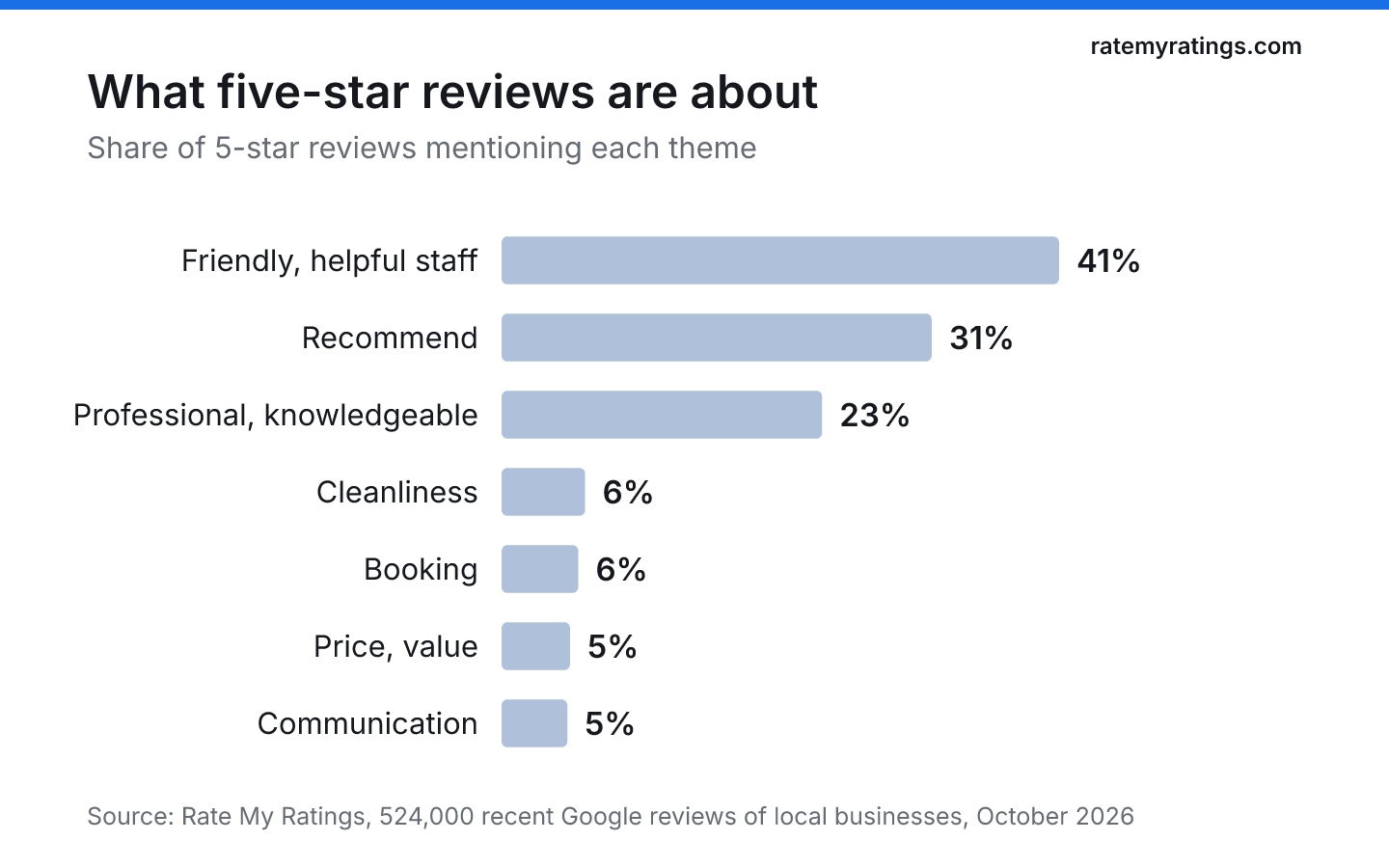
Only 5% of five-star reviews mention price or value. That does not mean price does not matter: it is the most common theme in one- and two-star reviews. It means price is something customers notice when it goes wrong, while the people are what they remember when it goes right. It is a useful reminder that what customers want is often not what businesses advertise.
Reading reviews this way across a whole market, competitors included, is what we do in Rate My Ratings reports. You can do a smaller version yourself with our guide to competitor analysis using Google reviews.
A twenty-minute customer interview guide
Use this with five to ten customers. It is enough to see patterns: the Nielsen Norman Group's long-standing advice for usability testing is that about five users reveal most problems, and small rounds repeated beat one big study.
Before you start (1 minute). "Thanks for your time. I'm trying to understand how people [do the task], not to sell you anything. There are no right answers."
The last time (8 minutes). Questions 1 to 5. Let them tell the story in order. Interrupt only to ask for detail.
The problem (5 minutes). Questions 6 to 9, then 10 to 13 on what they have tried.
Dig (4 minutes). Use questions 14 to 17 on the two or three moments that sounded most painful.
Close (2 minutes). Questions 18 to 20. Thank them.
Afterwards, write up each interview the same day: the problem in their words, what they tried, what it cost them and any exact phrases worth keeping. After five interviews, look for the problems that came up more than once.
When to use interviews and when to use a survey
Interviews tell you what matters and why. Surveys tell you how many people feel that way. Use them in that order: interview a handful of customers to find the problems, then survey a larger group to see how common each one is. Our guides to customer survey questions and survey questions about customer pain points cover the second step.
If you are testing a new product or service rather than improving an existing one, read how to research customer needs before launching a product as well.
The short version
- The best questions to ask customers are about what they did last time, not what they would do or what they think of your idea.
- Ask about the problem, what it costs them and what they have already tried. Money or effort already spent is the strongest sign of real demand.
- Follow up with "tell me more" and "why does that matter?" until the answer is specific.
- Avoid hypothetical, leading and feature-request questions.
- Check what you hear against reviews: customers praise people and complain about process, a pattern that runs through the local markets we have studied.
Frequently asked questions
- What are good questions to ask customers about their needs?
Ask about specific past events rather than opinions: when they last needed the product or service, what prompted the search, who else they considered, what has been hardest and what they have already tried. Follow up with 'tell me more' and 'why does that matter?' until you reach concrete details you can act on.
- Why shouldn't you ask customers what they want directly?
Because the answers are unreliable. People are polite, so they say they like your idea. They are poor at predicting what they will do or pay. And they describe solutions they have imagined rather than the problem they need solved. Asking about past behaviour avoids all three problems.
- How many customers should you interview?
Five to ten customers per round is usually enough for a small business to see repeated problems. Patterns start to appear after the first few conversations. It is better to run a few small rounds, changing your questions as you learn, than one large round you cannot adjust.
- Are customer interviews better than surveys?
They answer different questions. Interviews reveal what matters and why, including problems you did not know to ask about. Surveys measure how common those problems are across many customers. Interview first to find the issues, then survey to size them.

Rate My RatingsNewsletter
What reviews say about local markets, in your inbox.
New articles and findings from the blog, as they're published.
Check your inbox.
If this address isn't subscribed yet, we've sent it a link to confirm. Nothing is sent until you click it.
That didn't go through. Check the email address and try again.
Hold on a moment, then subscribe again.