
How to Research Market Demand for Your Business Idea
Demand is not whether people like your idea. It is whether enough of them are already spending money or effort on the problem, near you, and whether they would switch. Six steps to find out before you spend.

To research market demand for a business idea, look for evidence that people are already spending money, time or effort on the problem you want to solve, in the place you want to solve it. Search data shows whether people look for it. Competitor counts and their reviews show whether others already serve it, and how well. Conversations and a small pre-sale show whether people would switch to you. Opinions ("I'd definitely use that") are not demand; behaviour is.
Getting this wrong is expensive. In CB Insights' 2026 analysis of why venture-backed start-ups fail, poor product-market fit was cited in 43% of the 431 shutdowns it studied. Most local businesses are not start-ups, but the lesson carries: build for demand you have checked, not demand you hope for.
Here is a six-step way to research market demand that a single founder can do in a couple of weeks, mostly with free tools.
Step 1: write down who, what and where
Demand is always specific. "People want healthier lunches" is not testable. "Office workers within ten minutes' walk of the station want a hot lunch under ten pounds that is ready in five minutes" is.
Write one sentence covering:
- Who the customer is
- What problem they have, or what job they need done
- Where they are (for a local business, draw the catchment on a map)
- How they deal with it today
The last point matters most. There is almost always an existing alternative, even if it is "put up with it" or "drive to the next town". Your demand is the share of people who would switch from that alternative to you.
Step 2: check search demand
Search data is the cheapest signal of whether people actively look for what you plan to offer.
- Google Keyword Planner gives estimates of how many searches a keyword gets each month, and can be filtered by location. It is free with a Google Ads account. Look up the terms a customer would type: "pilates classes [town]", "emergency vet [area]", "wedding venue [county]".
- Google Trends shows whether interest is growing, shrinking or seasonal. Note how it works: Google says Trends figures are normalised to show relative popularity on a 0 to 100 scale, not absolute search volumes. Use it to compare terms and spot direction, not to count customers.
What to look for: steady or rising searches, searches with local intent ("near me", a town name), and searches phrased as problems ("my dog won't eat") as well as solutions. Low volume is not always fatal for a local service (many valuable services are searched for rarely), but zero volume on every phrasing is a warning.
Step 3: count the supply
Next, find out who already serves the demand.
- Search Google Maps for your category in your catchment and list every business you find, with its rating and number of reviews.
- For a wider view, the Office for National Statistics publishes counts of UK businesses by industry and area, and the Australian Bureau of Statistics publishes counts of Australian businesses with entries and exits by industry and region. A category with many new entries and few exits is usually growing.
Competition is not bad news. Several established competitors prove that demand exists. The question is whether they are full, whether customers are happy, and whether there is a type of customer nobody serves well.
Step 4: research market demand in competitors' reviews
This is the step most people skip, and it is the richest. Every competitor's Google reviews are a public record of real customers who paid for the service you are thinking of offering.
Volume tells you scale. Review counts are not customer counts (only some customers leave a review), but they are a fair relative signal of how much custom a category and a competitor see. They vary enormously by trade. Across the Google ratings of 46,800 local businesses we track in the UK and Australia, the median hotel has 596 reviews and the median restaurant 358, while the median electrician has 7 and the median roofer 6.
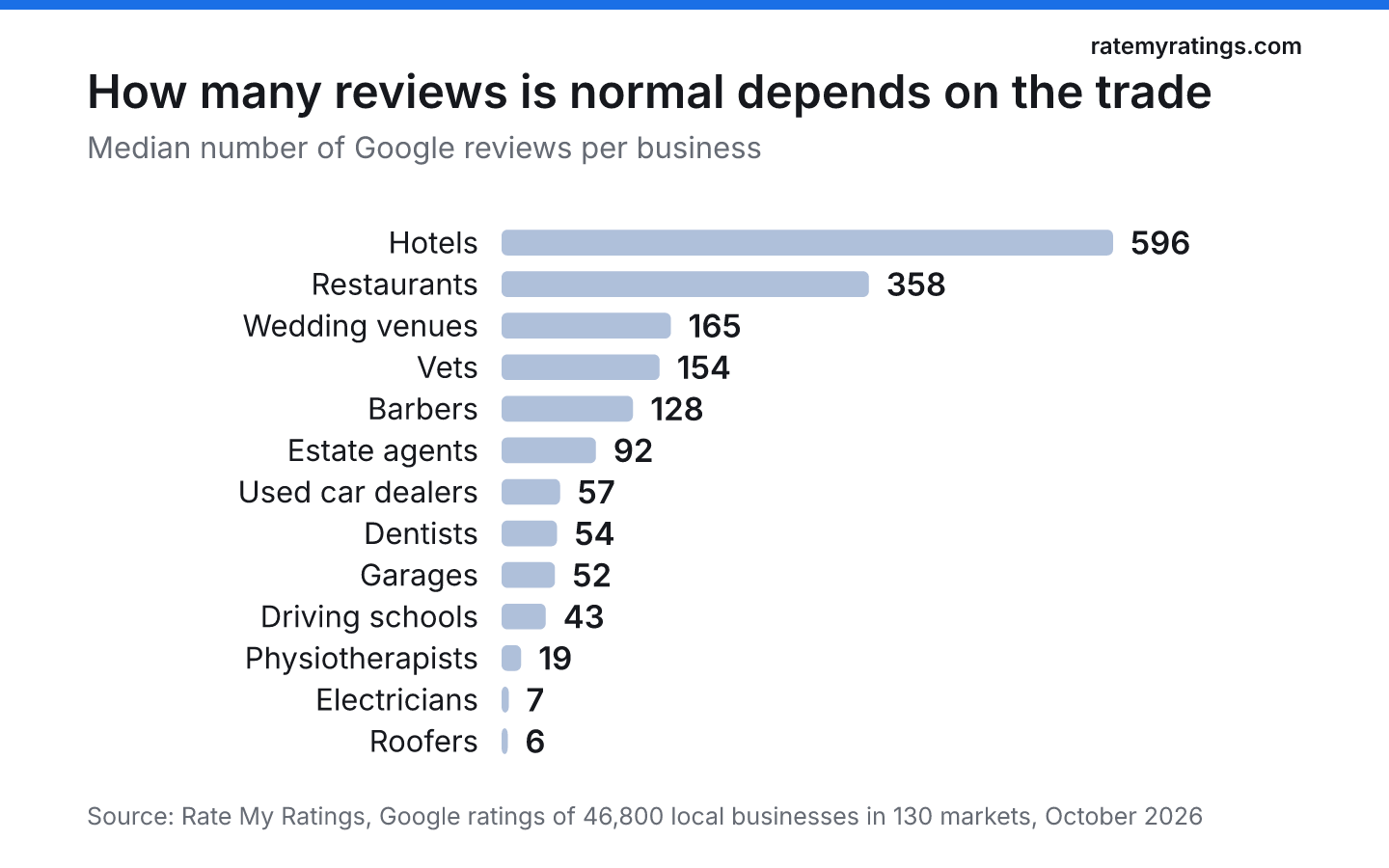
So compare a competitor with the norm for its category, not with businesses in other trades. A roofer with 60 reviews is unusually busy; a restaurant with 60 is quiet.
Recency tells you momentum. Sort competitors' reviews by newest. A business still collecting reviews every week is trading busily; one whose last review was months ago may be struggling.
Complaints tell you the gap. Unmet demand shows up as repeated complaints: no availability, long waits for appointments, nobody open at weekends, prices nobody explains. In the one- and two-star Google reviews of local businesses we have analysed, booking and cancellation problems appear in 22% and waiting or delays in 18%. If competitors' reviews in your area are full of "couldn't get an appointment for three weeks", that is demand they are failing to meet.
Our guide to competitor analysis using Google reviews shows how to do this systematically. A Rate My Ratings market report does it for every business in a category and area, which is the fastest way to see a market's demand and gaps in one place.
Step 5: talk to potential customers
Now test whether people with the problem would choose you. Talk to ten or so of them: people who match your "who", not friends and family.
Ask about what they did, not what they would do. "When did you last need this? Where did you go? What was annoying about it? What did it cost?" Our guide to questions to ask customers has a full interview script. The strongest sign of demand is someone who has already spent money or effort on a workaround. The weakest is enthusiasm for your idea.
If you want numbers, follow up with a short survey of a larger group, but remember that a survey of people who like you is not the market. We explain the difference in market research vs customer surveys.
Step 6: test with real commitment
Finally, ask for something that costs people a little. Commitment separates real demand from polite interest.
- A waiting list or landing page describing the service, with a sign-up form. Track how many sign up from a small amount of local advertising.
- Pre-sales or deposits, for example founding memberships for a studio, bookable before you open.
- A pop-up or trial: a weekend market stall, classes in a rented hall, a limited service from home.
Set a target before you start ("40 founding memberships in four weeks") so you cannot talk yourself into a weak result afterwards.
Putting a rough number on it
Once you have evidence, do a simple bottom-up estimate rather than quoting a national market size:
- People in your catchment who have the problem (from population figures and your research)
- multiplied by how often they buy
- multiplied by a realistic share you could win (look at how many competitors there are and how satisfied their customers seem)
- multiplied by your average price
For example, a studio in a town of 40,000 adults might assume that 3% of them, about 1,200 people, take pilates or a similar class around 40 times a year: 48,000 class visits. Winning a fifth of those at ten pounds a class would be about 9,600 visits, or roughly 96,000 pounds a year. Every input is a guess to check, but the arithmetic shows which assumption matters most, and that is where to research harder.
Signs of real demand, and warning signs
| Good signs | Warning signs |
|---|---|
| Steady or rising local searches | No searches on any phrasing of the problem |
| Several competitors with recent reviews | Competitors closing, or no new reviews in months |
| Repeated complaints about availability or waiting | Competitors' customers mostly happy, with no common gap |
| People already paying for workarounds | People say they like the idea but have never tried to solve the problem |
| Sign-ups or deposits that hit your target | Lots of likes, few sign-ups |
The short version
- To research market demand, look for behaviour, not opinions: searches, spending, workarounds and commitments.
- Use Keyword Planner for search volumes and Google Trends for direction (Trends is relative, not a count).
- Count competitors and read their reviews: volume shows scale, recency shows momentum, complaints show the gap.
- Talk to ten potential customers about what they did last time, then ask for a small commitment.
- Do the arithmetic bottom-up for your catchment, and research the assumption that moves the number most. For a new product rather than a new business, see how to research customer needs before launching a product.
Frequently asked questions
- How do you know if there is demand for a business idea?
Look for evidence that people already spend money, time or effort on the problem: local searches for it, established competitors with recent reviews, people paying for workarounds, and sign-ups or deposits when you offer it. Enthusiasm for your idea in conversation is not evidence of demand on its own.
- What free tools can I use to research market demand?
Google Keyword Planner for estimated monthly searches, Google Trends for whether interest is rising or falling, Google Maps to count and review competitors, and official statistics such as ONS business counts in the UK or ABS counts in Australia. Competitors' public reviews are also free and show what customers want and do not get.
- Is competition a bad sign when researching demand?
Usually not. Established competitors prove that customers exist and are paying. What matters is whether those competitors are full or failing their customers. Repeated complaints in their reviews about availability, waiting or service point to demand that is not being met, which is an opening for a new business.
- How accurate is Google Trends for measuring demand?
Google Trends shows relative interest, normalised to a 0 to 100 scale, not the number of searches. It is good for comparing terms, spotting seasonality and seeing whether interest is growing. For estimated search volumes use Keyword Planner, and treat both as signals to combine with other evidence.

Rate My RatingsNewsletter
What reviews say about local markets, in your inbox.
New articles and findings from the blog, as they're published.
Check your inbox.
If this address isn't subscribed yet, we've sent it a link to confirm. Nothing is sent until you click it.
That didn't go through. Check the email address and try again.
Hold on a moment, then subscribe again.