
How to Research Customer Needs Before Launching a Product
Most launches fail on needs, not execution. A practical sequence for finding what customers need before you build: start with what they already complain about, then interview, observe, test and rank.

To research customer needs before launching a product, work from evidence to opinion, not the other way round. Start with what customers already say about the products and services they use today (reviews and complaints are the richest free source), then interview a handful of target customers about how they handle the problem now, watch them do it if you can, test a rough version with five or so people, and only then rank the needs you will build for. Each step is cheap; skipping them is not.
This guide walks through that sequence for a new product or a new service from an existing business: a vet practice adding a pet dental plan, a garage launching a mobile repair van, a café starting a lunch delivery round.
Needs, wants and requests are different things
When you research customer needs, keep three things apart:
- A request is what a customer asks for: "Can you do evening appointments?"
- A want is the solution they have in mind: "I want to come after work."
- A need is the underlying problem: "I can't take time off to bring the dog in."
Evening appointments are one answer to that need. Collection and drop-off, a weekend clinic or a video consultation might be better ones. Clayton Christensen and his co-authors call this the "job to be done" in their Harvard Business Review article Know Your Customers' Jobs to Be Done: customers "hire" a product to make progress in a particular situation, and understanding the situation matters more than the feature list.
Step 1: start with what customers already complain about
Before you speak to anyone, read what customers have already written about the products and services you would compete with. Reviews of existing alternatives are a free, unprompted record of unmet needs.
The negative ones are the most useful, because they are the most detailed. Across the 524,000 recent Google reviews of local businesses we have collected in the UK and Australia, the median one-star review is 74 words long and the median five-star review just 27.
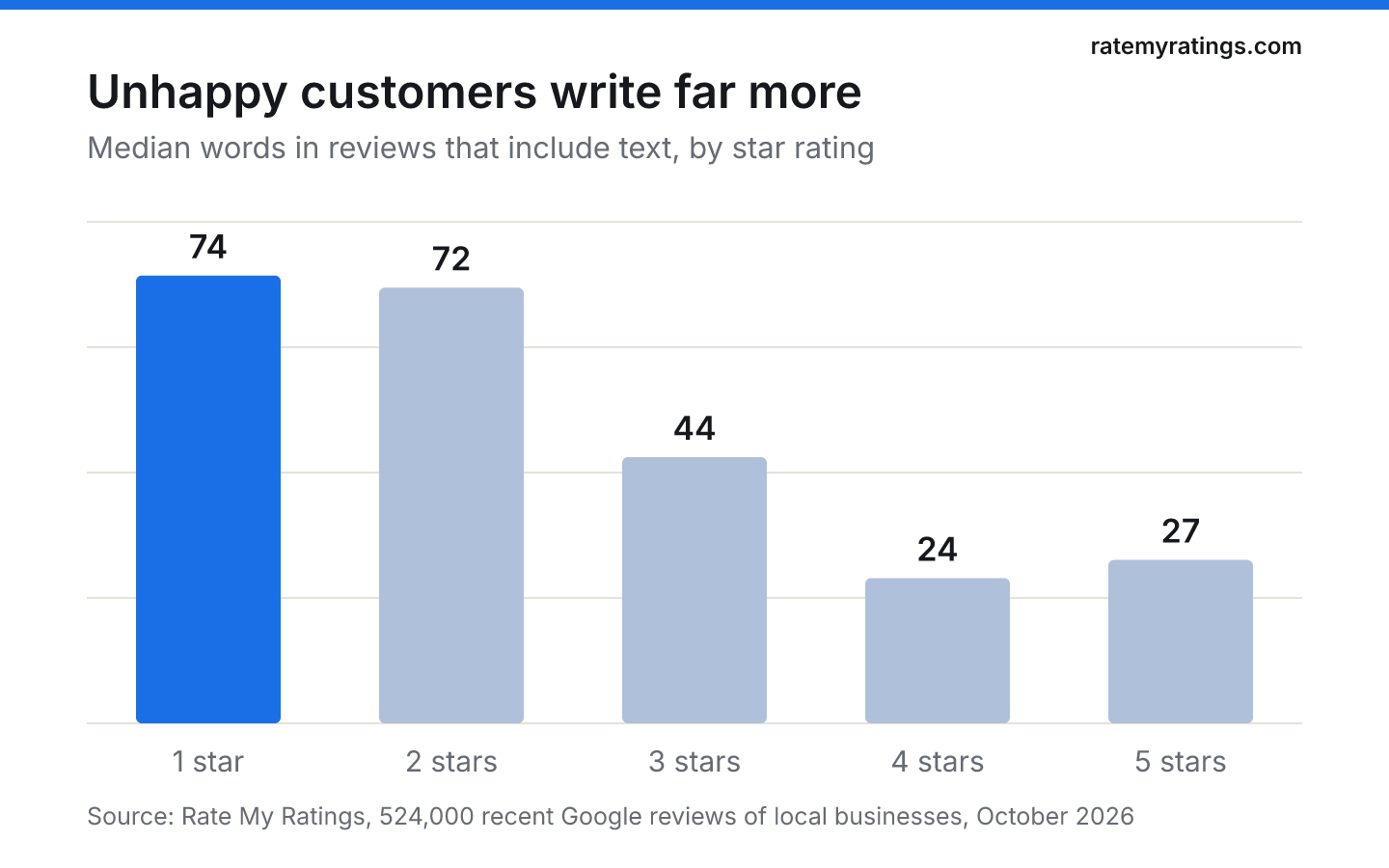
A happy customer writes "Great service, highly recommend." An unhappy one describes exactly what they needed and did not get. Read the one-, two- and three-star reviews of the five or ten nearest alternatives to your idea and list every need you see. Typical patterns:
- "Couldn't get an appointment for three weeks" (a need for availability)
- "The quote doubled when they started" (a need for price certainty)
- "Nobody told me anything until I chased" (a need to be kept informed)
These match what we see across whole markets: in one- and two-star reviews of local businesses, price surprises come up in 25%, communication in 22%, and booking or cancellation problems in 22%. Our guide to competitor analysis using Google reviews shows how to do this methodically, and a Rate My Ratings report does it for every business in a category and area.
Do not stop at local reviews. Product reviews on retailer sites, forum threads and social media comments about the alternatives all help. Note the customers' own words: they become your interview prompts and, later, your marketing copy.
Step 2: research customer needs through interviews
Next, talk to eight to ten people who have the problem. Not friends, not family: people who match your target customer and have dealt with the problem recently.
Ask about what happened, not what they would like. The Nielsen Norman Group's guide to user interviews recommends asking about specific past events ("Tell me about the last time you...") because they are remembered more accurately than general habits, and warns that leading questions undermine everything you hear.
Focus on four things:
- The situation that triggered the need
- What they did about it, step by step
- What they tried before, and why it fell short
- What it cost them in money, time or worry
Our guide to questions that reveal what customers really want has a full question list and interview script.
Step 3: watch, if you can
What people say they do and what they actually do differ. Where possible, observe:
- Sit in a waiting room, a showroom or a shop for an hour and note what people struggle with.
- Ask a customer to show you how they currently book, order or compare options on their phone.
- Do the task yourself as a customer of a competitor, and note every point of friction.
Observation catches needs people have stopped noticing because they have learnt to work around them.
Step 4: test a rough version with five people
Before building the real thing, put something rough in front of people: a one-page description, a price list, a mock-up of a booking screen, a trial service run by hand. Then watch them use it or react to it.
You do not need many testers. Jakob Nielsen's long-standing guidance is that testing with about five users finds most problems, and that several small rounds beat one large one. Fix what the first five reveal, then test again with five more.
Watch for confusion (what did they misunderstand?), hesitation (where did they stop?) and questions (what did they need to know that you did not tell them?). Each is an unmet need in your design.
Step 5: rank the needs
By now you will have a long list. Rank it before you build, using three questions for each need:
| Question | Why it matters |
|---|---|
| How many target customers have it? | A need only two people mentioned is not a product |
| How painful is it? | Customers pay to remove serious problems, not mild irritations |
| How badly do existing options meet it? | A need competitors already meet well is a hard place to win |
If you need numbers for the first two, run a short survey of a larger group once interviews have told you what to ask. Our guide to customer pain points questions shows how to measure frequency and severity, and market research vs customer surveys explains why that survey should reach beyond your existing customers.
Build first for the needs that are common, painful and badly served.
Step 6: check that the need comes with demand
A real need is not the same as a market. Before launch, check that enough people have it and will pay to solve it: search interest, competitor activity, and some form of commitment such as a waiting list or deposits. We cover that in how to research market demand for your business idea.
This is the step that saves the most money. In CB Insights' 2026 analysis of why start-ups fail, poor product-market fit was cited in 43% of 431 failed venture-backed companies.
A two-week plan
| Days | Activity | Output |
|---|---|---|
| 1 to 2 | Read reviews of 5 to 10 alternatives | A list of needs in customers' own words |
| 3 to 7 | Interview 8 to 10 target customers | The situations, workarounds and costs behind each need |
| 8 | Observe the task in person | Needs people no longer notice |
| 9 to 11 | Test a rough version with 5 people, fix, test again | A design that works for real users |
| 12 to 14 | Rank needs; check demand | A short list of what to build first |
Common mistakes
- Asking people to design the product. Customers are experts in their problems, not in your solution.
- Researching only existing customers. They already chose you. The needs you are missing belong to people who went elsewhere.
- Stopping at the first answer. "It's too expensive" usually means "I can't see what I'm paying for". Ask why.
- Treating one loud voice as a trend. One detailed complaint is a lead. The same complaint from many customers is a need.
The short version
- To research customer needs, separate requests and wants from the underlying problem.
- Start with reviews of the existing alternatives, especially the negative ones: unhappy customers write nearly three times as much and describe exactly what they needed.
- Interview eight to ten target customers about what they did last time, and observe the task where you can.
- Test a rough version with about five people, fix it, and test again.
- Rank needs by how common, how painful and how badly served they are, then check there is enough demand to build a business on.
Frequently asked questions
- What is the best way to research customer needs?
Combine evidence sources rather than relying on one. Read reviews and complaints about existing alternatives, interview eight to ten people who have the problem about what they did last time, observe the task if you can, and test a rough version with about five people. Use surveys afterwards to measure how common each need is.
- What is the difference between a customer need and a customer want?
A need is the underlying problem a customer is trying to solve, such as not being able to take time off work. A want is the solution they imagine, such as evening appointments. Researching the need opens up better solutions than simply delivering the want customers first ask for.
- How many customers should I talk to before launching?
Eight to ten interviews with people who match your target customer usually reveal the main needs, because the same problems start repeating. For testing a prototype, around five people per round finds most problems. Run several small rounds and adjust between them rather than one large round.
- Can online reviews help with customer needs research?
Yes, and they are often the best place to start. Reviews of existing products and services are unprompted and specific, and negative ones are especially detailed. In our data the median one-star Google review is 74 words long against 27 for a five-star review, so unhappy customers describe what they needed and did not get.

Rate My RatingsNewsletter
What reviews say about local markets, in your inbox.
New articles and findings from the blog, as they're published.
Check your inbox.
If this address isn't subscribed yet, we've sent it a link to confirm. Nothing is sent until you click it.
That didn't go through. Check the email address and try again.
Hold on a moment, then subscribe again.